


The Founder’s T-Shirt: Part II — The Production
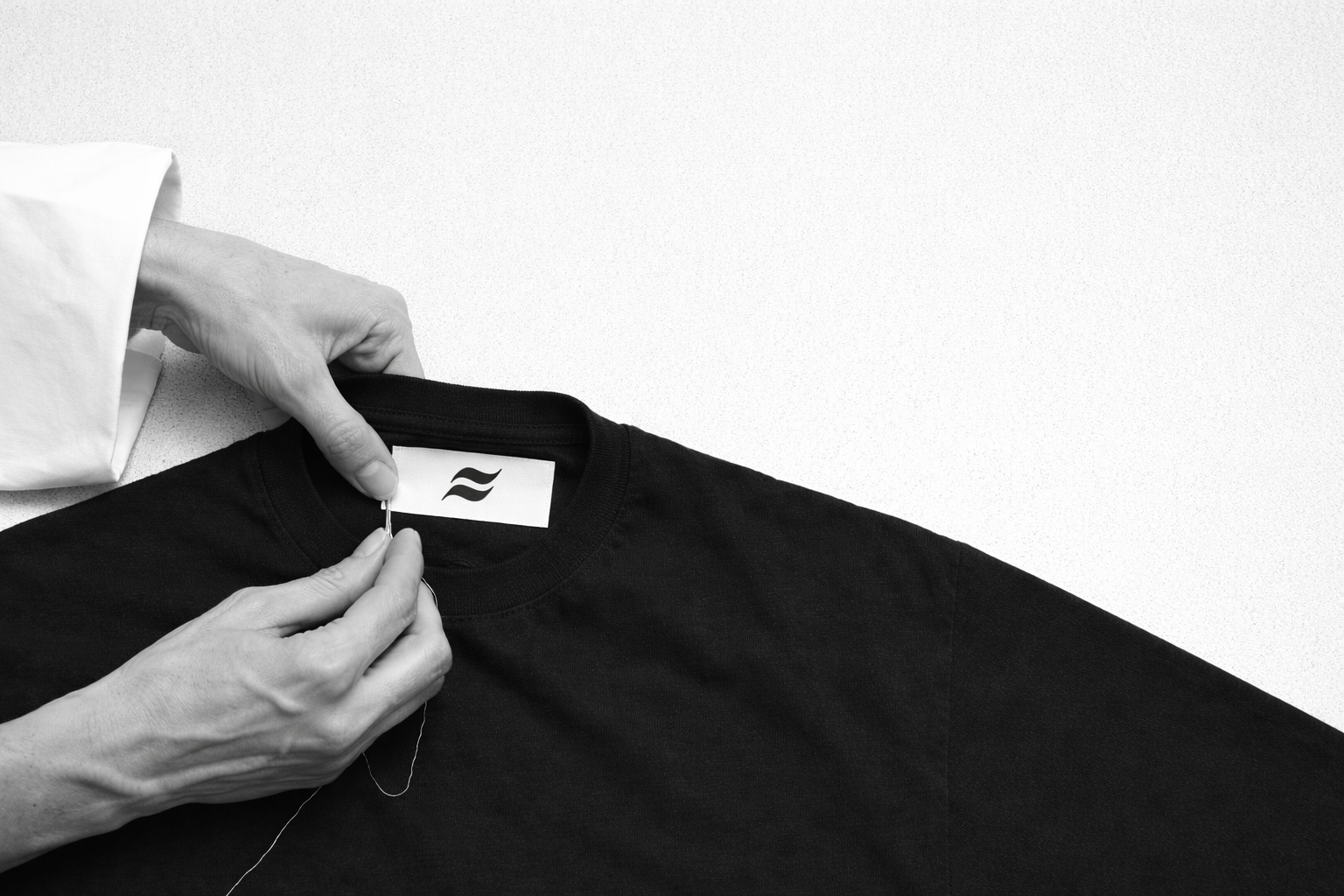
In Part I, we talked about the line.
what you dropping today?Not a slogan. A shove.
Now we’re going to talk about what it takes to nail that shove on cotton.
Because from the outside you see a black tee with a red wave and a line on the back.From the inside, it’s months of tests, calls, burns, rejects, and a production chat that still pings at odd hours.
This isn’t merch. It’s a mirror.And mirrors don’t get a pass on quality.
STUDIO NOTES
A slow Tuesday. The kind that hums like a fridge—background noise, no spark. We taped black cotton to the wall and dragged a red pencil from the shoulder line toward the hem. It didn’t obey. The line curved, wandered, and then—click—it felt like a fuse: thought → action.
Mock one sat too flat.
Mock two yelled. Mock three changed ink: puff print.
Heat hit the ink; it rose a few millimeters and turned tactile. The wave on the chest puffed just enough to catch light. Run a finger over it and you feel the beat. On the back, the fuse thickened into letters. The question didn’t just read; it pushed.
We tweaked by millimeters—where the curve kisses the collar, how the baseline rides the hem, how the puff edges keep clean after wash two. When the tee finally read like a story—spark, flow, demand—we stopped.
Then we hit the shoulder seam.
That little ridge of stitching is a speed bump for ink — especially puff. One wrong placement and the red line “breaks” right where the front meets the back. Like the fuse stuttered mid-sentence.
We chased that one problem for days: flattening the seam, shifting the path by a few mm, testing angles so the line crosses stitching clean, not straight into it. Rejecting anything where the red split, skipped, or cracked after wash one.
It had to flow from chest centre to back in one breath. No gap. No apology.
Front: a small red wave near the heart.Back: the fuse runs south and swells into a dare:
what you dropping today?
Wear it to the office. Or to the factory. Or in the car on a grim Tuesday when Slack is yapping and you still owe four briefs, two mocks, and one apology.
THE ORDEAL (AKA HOW A SIMPLE TEE EATS MONTHS)
You see a t-shirt. We see a supply chain with opinions.
30+ manufacturers screened on quality, speed, and whether they answer when it’s not fun.
One vendor chosen after months of calls, samples, more calls.
Gurgaon ↔ Bangalore back-and-forth. Not close.
10+ samples that were almost right, never right. Adjust, wait, adjust again.
On most days, this would be a job for the operations chat. Instead, you had Chirag (Founder, Breeze) in the middle of it.
He was on vendor calls where the safe answer was “this is fine,” and he kept saying, “It’s not fine if it feels like conference swag.”
He compared tees on video like a fit reviewer: “This shoulder drop is wrong. This red dies under yellow light. This print feels like a sticker.”
Founders know this energy. The “quick tee” that somehow chews through a quarter — not because people are slow, but because the bar is high and the founder refuses to drop it.
Ink, heat, and way too many red swatches
And then the part you don’t see on Instagram: ink science.
We tested three puff bases to land a rise you can feel without turning the tee into armor.
Early swatches cracked at low cure temps; higher temps solved that but dulled the red.
Final pass: 160–165°C for 2 minutes, then cool under light pressure. Puff stayed crisp, red stayed red.
We chased the exact pantone so the wave reads red under street lamps, office LEDs, and sunlight. No brown cast, no orange drift.
Print depth had to sit in the fabric, not like a sticker. Soft-hand base layer first, puff on top, one clean pull.
Every D2C founder knows this beat. The “simple” thing never ships simple. You fight for fabric weight, print depth, and the way the S in “today” breathes. You sign off at 1 a.m., then reject at 9 a.m. because the curve doesn’t breathe.
Shipping a physical thing is a contact sport. This tee took punches. It also hits back.
WHY WE CARED THIS MUCH
Because we live with the same stakes you do.
We’ve spent nights doing size-curve math and arguing over a red that reads the same under street lamps and office LEDs. We know the sinking feel of a late batch, the thrill of a perfect one, and the quiet wins no one sees.
We couldn’t make a tee for founders that didn’t pass the same test you use for your own drops:
Does it feel right on body, not just on a mockup?
Does it survive bad lighting?
Does the print hold up after real life, not just a shoot?
We sweated the millimeters because that’s the job. Not to make hype, but to make something a founder can wear into a standup, a factory, or a warehouse and feel like it was built by people who actually get it.
FIELD TESTS
Quality Heavier fabric, no cling. Raised print you can feel. No cheap shine. The red stays red even when the lighting doesn’t help.
Fit Relaxed but intentional. You look like you meant to wear it, not like you grabbed the nearest freebie.
Care tag Our favourite line:
Wash when it starts to smell. Handle with care, or don’t ;)
Founders don’t need instructions on how to use soap.
WHO IT’S FOR
Founders who don’t need a pep talk. Operators who know the hardest part isn’t ideas; it’s the drop. If that’s you, the shirt is both a dare and a diary entry.
CREDITS (AND SCARS)
Art direction by a team that argued about kerning like it was rent.
Production by a vendor who now has a dedicated “Breeze thread” on WhatsApp.
Logistics run by caffeine.Final sign-off by the voice in your head that asks, again, what you dropping today?
If you’ve ever fought for a millimeter, you already know why this mattered.
Author

Share

